-
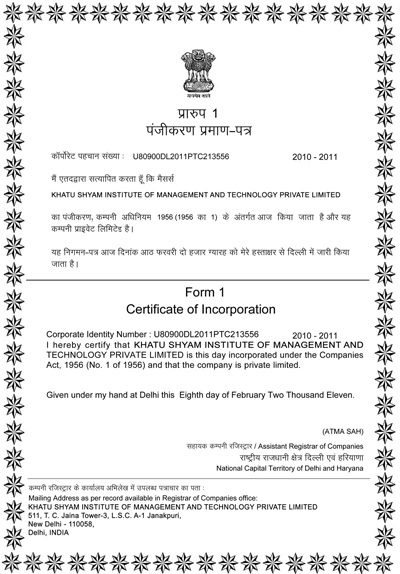 National Registrar Ministry of Corporate (Govt. of India).
 -
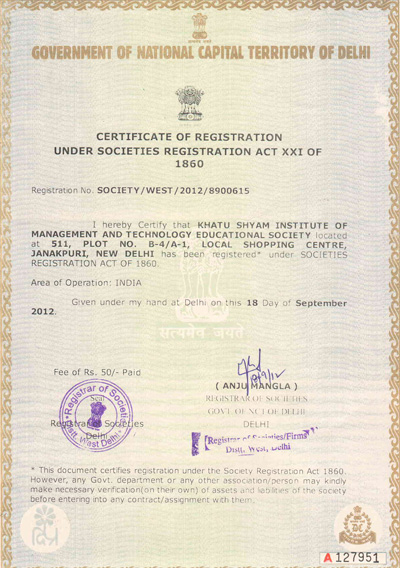 Registrar By NCT, Govt. of Delhi.
 -
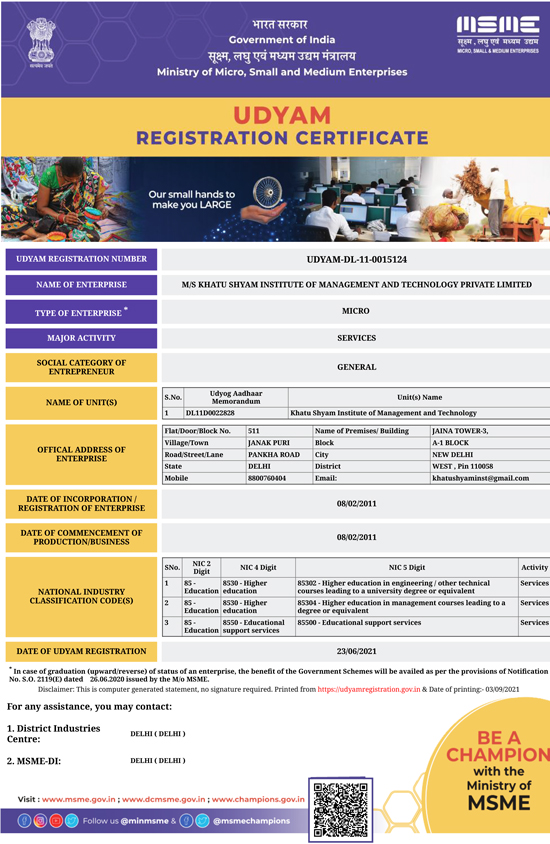 Register By Ministry of MSME, Govt. of India
 -
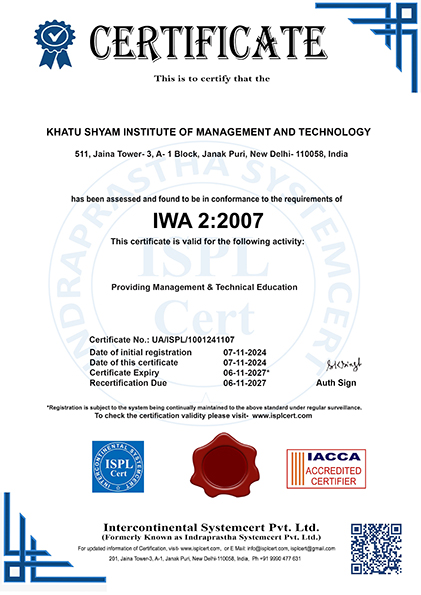 WA 2:2007 Certified By Indraprastha SystemCert Pvt.Ltd is Accredited By Integrated Accreditation Centre For Certification (IACCA) http://www.www.iacca.in
 -
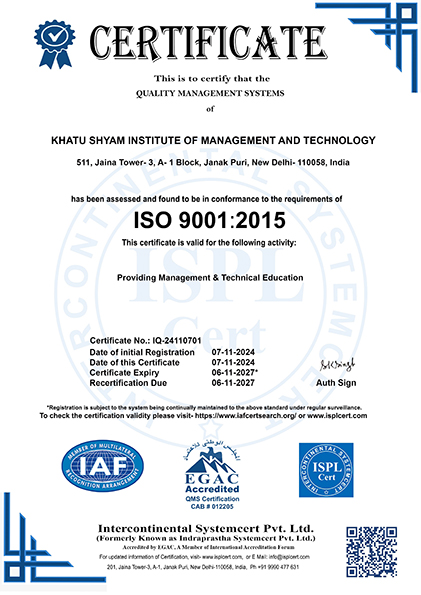 An ISO 9001-2015 Certified By Indraprastha SystemCert Pvt.Ltd is Accredited By Emirates International Accreditation Center (EIAC) https://www.eiac.gov.ae
 -
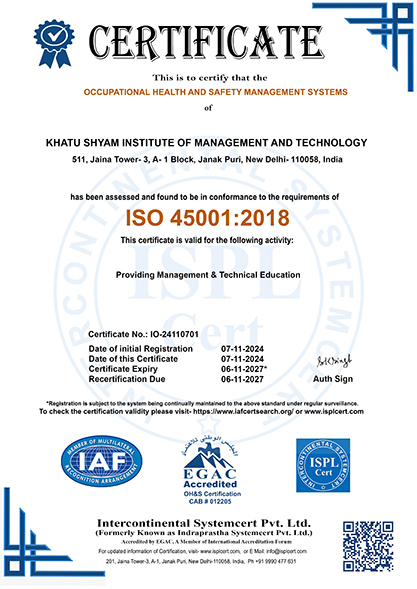 An ISO 45001:2018 Certified By Innovative SystemCert Pvt.Ltd is Accredited By Egyptian Accreditation Council, (EGAC) http://www.egac.gov.eg
 -
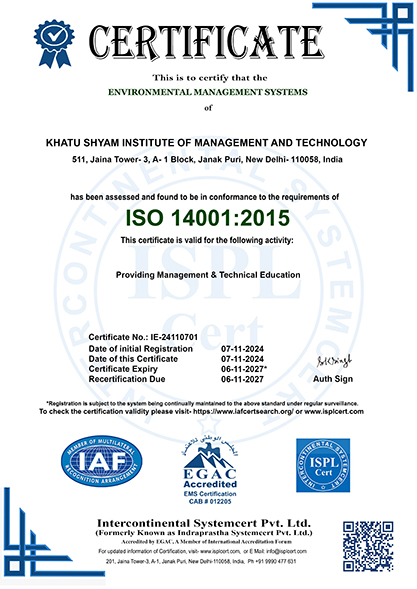 An ISO 14001:2015 Certified By Innovative SystemCert Pvt.Ltd is Accredited By Egyptian Accreditation Council, (EGAC) http://www.egac.gov.eg
Bachelor Program in Petrochemical Engineering for Working Professionals
Khatu Shyam Institute of Management & Technology (KSIMT®) offers the Bachelor Program in Petrochemical Engineering for experienced working professionals who want to strengthen their theoretical knowledge of petrochemical processes, refinery operations and industrial systems while continuing their existing employment.
The program covers petrochemical process technology, petroleum refining, thermodynamics, fluid mechanics, heat transfer, reaction engineering, process equipment, instrumentation, polymers, separation processes, plant design, industrial safety and process optimization.
Designed for Experienced Working Professionals
Minimum 3 Years of Relevant Work Experience
Regular Entry: 4 Years | Eligible Lateral Entry: 3 Years
100% Theoretical Learning | Digital E-Books | No Regular Classroom Attendance
KSIMT® is ISO Certified and operates under the guidelines set by the Government of Delhi and Government of India.
Work + Study = Success
- Designed for experienced working professionals
- Minimum 3 years of relevant work experience
- 100% theoretical learning model
- Digital e-books
- Flexible learning alongside employment
- No regular daily classroom attendance
- No regular laboratory or plant attendance
- Regular Entry and eligible Lateral Entry
- Examination and assignment support
- Online Examination Result / Verification
- Academic and documentation support
Professionals often search for distance engineering, online engineering, correspondence engineering, distance learning engineering, distance education engineering and work-integrated engineering because attending a regular daily college may not fit around employment, plant shifts, refinery operations, project schedules or family responsibilities.
For experienced petrochemical professionals, the challenge is often not willingness to continue learning. The real challenge is finding a study structure that can fit around the career and responsibilities they already have.
KSIMT® provides a flexible theoretical learning model through digital e-books, remote academic support and applicable examination processes, helping eligible working professionals continue learning while remaining employed.
This makes the program relevant to professionals searching for engineering for working professionals without unnecessarily interrupting their existing professional experience.
Professionals working in petrochemical plants, refineries, process industries, oil & gas operations and manufacturing environments often spend years building practical knowledge through plant operations, production, maintenance, safety, process monitoring and project responsibilities.
Returning to a regular daily college may become difficult once a professional is already managing shift duties, income commitments, family responsibilities, site requirements or overseas employment.
For many experienced professionals, leaving an existing job only to attend regular classroom study is not a practical option.
KSIMT® helps bridge this gap by providing eligible professionals with a structured theoretical learning pathway that can be managed alongside employment.
Build academic understanding around the petrochemical experience you have already developed through work.
The program is primarily designed for experienced professionals working in petrochemical, refinery, process, chemical, oil & gas or related industrial environments.
It may be suitable for professionals involved in:
- Petrochemical Plant Operations
- Refinery Operations
- Process Operations
- Production
- Process Maintenance
- Chemical Processing
- Industrial Safety
- Quality Control
- Plant Utilities
- Process Instrumentation
- Oil & Gas Operations
- Polymer & Chemical Industries
- Process Equipment
- Industrial Projects
Technicians, supervisors, operators, production personnel, maintenance professionals, technical executives and other experienced personnel may apply according to their educational qualification, work experience and applicable eligibility requirements.
Strengthen the theoretical side of the petrochemical and process-industry experience you already use in your professional role.
Applicants must have a minimum of 3 years of relevant work experience in the same or related field along with the applicable previous educational qualification.
Freshers are not eligible.
Educational Qualification: 12th Grade with PCM – Physics, Chemistry and Mathematics, or applicable equivalent qualification
Relevant Work Experience: Minimum 3 Years
Program Duration: 4 Years
Admission is considered on the basis of educational qualification, relevant professional experience and applicable documents.
Educational Qualification: Applicable 3-Year Engineering Diploma in a relevant field
Relevant Work Experience: Minimum 3 Years
Program Duration: 3 Years
Eligible Diploma holders may be considered for Lateral Entry according to their technical qualification, relevant work experience and document review.
Your previous technical qualification and relevant industry experience are reviewed to identify the applicable entry route.
Government employees should obtain the applicable departmental NOC before admission.
The Bachelor Program in Petrochemical Engineering develops structured theoretical understanding of petrochemical processing, refinery systems, chemical engineering principles and industrial plant operations.
Key Study Areas:
Petrochemical Engineering • Petroleum Refining • Process Technology • Thermodynamics • Fluid Mechanics • Heat Transfer • Chemical Process Principles • Reaction Engineering • Process Equipment Design • Instrumentation & Control • Industrial Safety • Polymer Science • Separation Processes • Plant Design • Process Simulation • Energy Utilization
These study areas help working professionals understand the engineering principles behind petrochemical plants, refinery processes, conversion systems, process equipment and industrial operations.
- Engineering Mathematics – I
- Engineering Physics
- Engineering Chemistry
- Basics of Mechanical Engineering
- Introduction to Petrochemical Industry
- Fundamentals of Thermodynamics
- Environmental Science
- Engineering Mathematics – II
- Fluid Mechanics
- Chemical Process Principles
- Petroleum Geology
- Heat Transfer in Petrochemical Processes
- Organic Chemistry
- Computer Applications in Engineering
- Petrochemical Process Technology
- Reaction Engineering
- Refining and Petrochemical Processes
- Industrial Safety and Hazard Management
- Process Equipment Design
- Chemical Instrumentation and Control
- Energy Resources and Utilization
- Advanced Petrochemical Technology
- Polymer Science and Technology
- Petroleum Reservoir Engineering
- Chemical Plant Design and Economics
- Process Simulation and Optimization
- Modern Separation Processes
- Renewable Energy in Petrochemical Applications
The syllabus follows the applicable theoretical academic structure and may be updated according to academic requirements.
Develop theoretical understanding of the processes used to convert petroleum-based feedstocks into petrochemical products and industrial materials.
Study theoretical concepts related to petroleum refining, process conversion, refinery operations and integration between refining and petrochemical systems.
Understand fluid-flow behaviour and heat-transfer principles that are important in pipelines, processing equipment and industrial process systems.
Build theoretical understanding of chemical reactions, reaction systems and engineering concepts used in industrial process operations.
Study engineering principles associated with process equipment used across petrochemical and chemical processing environments.
Develop understanding of measurement, instrumentation and control concepts used for monitoring and managing industrial processes.
Study theoretical principles related to industrial hazards, process safety and safer working environments in petrochemical and process industries.
Understand polymer technology and theoretical separation processes used within petrochemical and related industries.
Develop theoretical understanding of process analysis, simulation concepts and approaches used to improve industrial process performance.
The Bachelor Program in Petrochemical Engineering follows a 100% theoretical learning model structured for experienced working professionals.
Applicable study material is provided through digital e-books, allowing students to manage theoretical learning around plant schedules, shift duties, projects and other professional responsibilities.
The learning structure includes theoretical study, flexible self-study, applicable assignments, examinations and academic guidance.
No regular daily classroom, laboratory or plant attendance is required under the theoretical learning model.
Continue your existing employment while managing theoretical study according to your available time.
Petrochemical and refinery professionals may already be managing rotating shifts, plant responsibilities, production schedules, projects, regular income and family commitments.
Leaving employment for regular classroom study may involve:
- Income interruption
- Loss of professional continuity
- Fixed classroom schedules
- Relocation
- Accommodation expenses
- Time away from plant or project responsibilities
- Difficulty managing shift-based employment
The need is to continue learning without unnecessarily putting years of industry experience, income and existing responsibilities on hold.
KSIMT® helps eligible working professionals manage both continued employment and structured theoretical learning.
Continue Working. Continue Learning. Build on the Experience You Already Have.
Eligible petrochemical, refinery, chemical-process and oil & gas professionals working across India and international locations can explore the program remotely.
The program may be relevant for professionals working in the UAE, Saudi Arabia, Kuwait, Qatar, Oman, Bahrain and other international locations, particularly those involved in refineries, petrochemical plants, process industries, production, maintenance, industrial safety and plant operations.
Eligible overseas professionals can access applicable learning material and student support remotely while continuing their existing employment.
Total Bachelor Program Fee: INR 65,500/-
The applicable program fee includes:
- Admission Fee
- Digital E-Books
- Examination Fee
- Student ID
- Applicable Taxes
One-Time Payment | 3-Month EMI | 6-Month EMI
Flexible payment options help working professionals plan education expenses alongside regular income and other financial responsibilities.
Payments should be made only through authorised KSIMT® payment channels.
Enquiry - Eligibility Review - Document Review - Admission Confirmation - Student Login - Digital ID Card - Digital E-Books - Academic Information - Examination - Examination Result - Verification - Academic Documents
The admission process gives working professionals a clear journey from initial eligibility review through applicable program completion and academic documentation.
The Bachelor Program in Petrochemical Engineering follows a theoretical examination and assignment-based academic assessment process.
Students receive applicable information regarding:
- Examination schedules
- Theory-based question papers
- Assignment requirements
- Subject-wise instructions
- Submission procedures
- Applicable deadlines
Applicable examination answers or assignments are submitted according to the instructions communicated by KSIMT®.
After evaluation, the Examination Result is processed according to the applicable examination cycle.
KSIMT® provides applicable academic and administrative support throughout different stages of the student journey.
Services may include:
- Admission Guidance
- Eligibility Review
- Documentation Support
- Digital E-Books
- Student Login
- Digital Student ID Card
- Examination Guidance
- Examination Result
- Online Result / Verification
- Transcript
- Verification Letter
- Migration
- Consolidated Marksheet
- Medium of Instruction
- Character Certificate
- Provisional Documentation
- Applicable Apostille & Embassy Attestation Support
KSIMT® support extends from admission and study material to examination, result verification and applicable academic documentation.
Experienced professionals need an education model that can realistically fit around employment, plant schedules, industry experience, available time and financial responsibilities.
KSIMT® focuses on these practical requirements through:
- Programs structured for experienced working professionals
- Relevant work-experience based admission criteria
- Distance, Online, Correspondence and Work-Integrated learning support
- 100% theoretical learning
- Digital e-books
- No regular daily classroom attendance
- Ability to continue existing employment
- Petrochemical and engineering specialization options
- Examination and assignment support
- Online Examination Result / Verification
- Academic documentation services
- Flexible payment options
- India and international accessibility
You have already invested years in building practical petrochemical, refinery or process-industry experience. KSIMT® provides eligible working professionals with a structured way to strengthen the theoretical side of that experience without unnecessarily putting their existing career on hold.
KSIMT® is ISO Certified and operates under the guidelines set by the Government of Delhi and Government of India.
Candidates should have the applicable previous qualification and minimum 3 years of relevant professional experience in the same or related field.
No. Freshers are not eligible. The program is structured for experienced working professionals.
Candidates should generally have 12th Grade with Physics, Chemistry and Mathematics (PCM) or applicable equivalent qualification along with the required relevant work experience.
Candidates with an applicable 3-Year Engineering Diploma in a relevant field, along with the required relevant work experience, may be considered for Lateral Entry.
Regular Entry: 4 Years
Eligible Lateral Entry: 3 Years
Yes. The program follows a flexible theoretical learning structure designed for working professionals exploring distance engineering, online engineering, correspondence engineering or work-integrated engineering options while continuing employment.
Yes. The program is structured to help eligible working professionals manage theoretical learning alongside existing employment.
No. The program follows a 100% theoretical learning model and does not require regular daily classroom, laboratory or plant attendance.
Applicable theoretical study material is provided through digital e-books.
Major subjects include Petrochemical Process Technology, Refining Processes, Reaction Engineering, Process Equipment Design, Instrumentation & Control, Polymer Science, Plant Design, Separation Processes and Process Simulation.
The total Bachelor Program Fee is INR 65,500/-, including applicable admission fee, digital e-books, examination fee, Student ID and taxes according to program terms.
Yes. Applicable 3-month and 6-month EMI options are available according to admission terms.
Yes. Eligible working professionals from UAE, Saudi Arabia, Kuwait, Qatar, Oman, Bahrain and other international locations may enquire remotely, subject to applicable admission eligibility.
Yes. KSIMT® provides an applicable Online Examination Result / Verification facility for student records.
Professional experience in petrochemical, refinery and process industries takes years to build. The KSIMT® Bachelor Program provides eligible experienced professionals with a flexible theoretical learning pathway to strengthen their Petrochemical Engineering knowledge while continuing their existing careers.
Minimum 3 Years Relevant Work Experience | 100% Theoretical Learning | Digital E-Books
KSIMT® | Work + Study = Success
Course Offered By: KSIMT under autonomous mode through distance education
Request a Callback
Admission Guidance for Working Professionals With 3+ Years of Relevant Work Experience